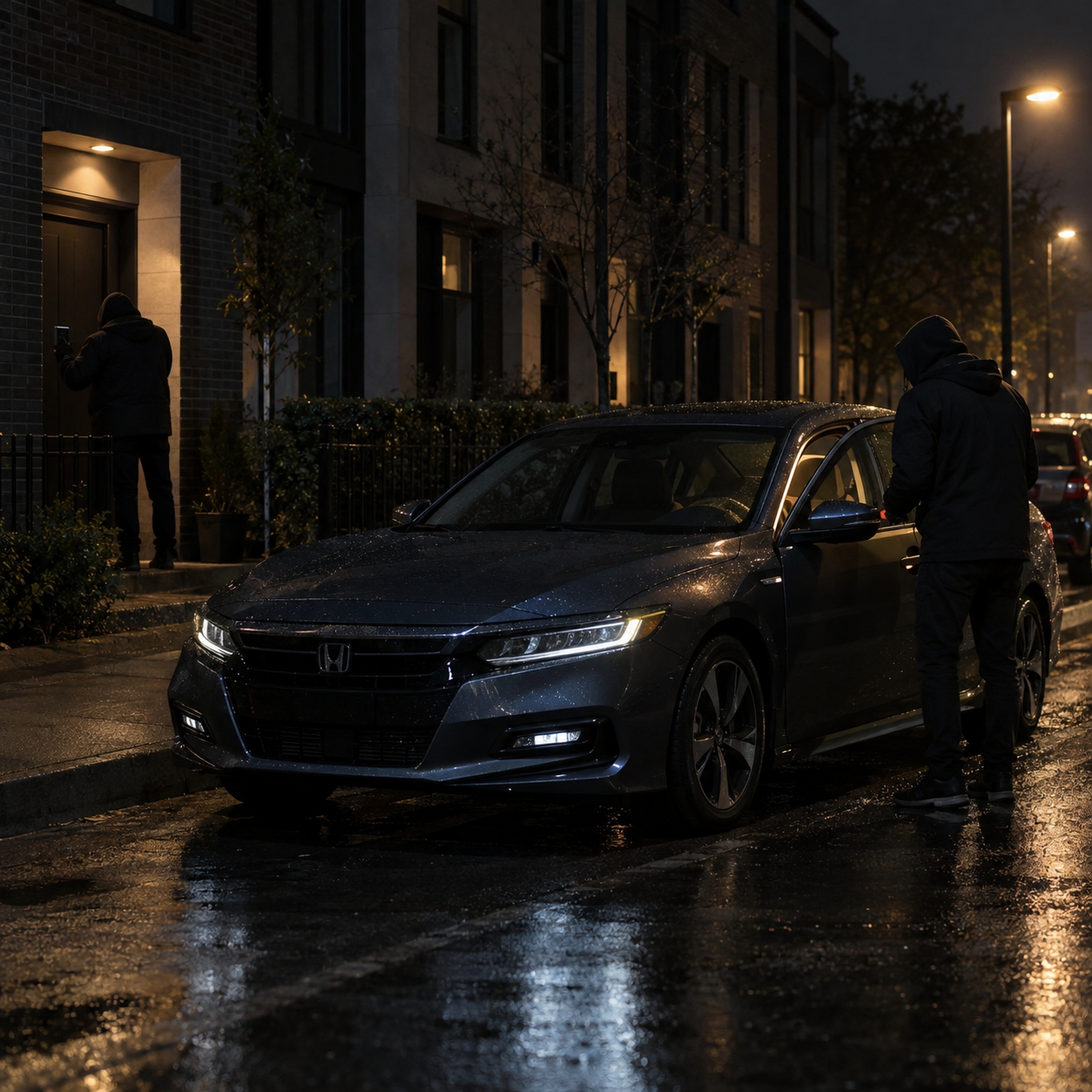
How relay attacks work — and why your Honda is vulnerable
Modern Hondas with keyless entry use passive RFID. The key fob constantly emits a low-power signal. When the fob is close to the vehicle, the car detects the signal and allows entry and ignition. The design intent is convenience — you walk up, the car recognizes your key, you get in.
The vulnerability is that "close" is relative. Signal amplifiers can extend the reach of that passive signal by 30 to 100 feet. In a relay attack, one thief stands near wherever you keep your keys — by your front door, near your bedroom window — and their amplifier picks up the signal. A second thief stands by your vehicle with a receiving device. The car thinks the key is there. It unlocks. The engine starts.
No broken windows. No OBD programming device. No visible evidence of how they got in. Your insurance adjuster sees a car that drove away with no signs of forced entry and the investigation starts there.
What a Faraday bag does
A Faraday bag is a pouch lined with signal-blocking metallic mesh. When you put your key fob inside and close it, the fob's RFID and radio signals are contained. The car cannot detect the fob. Thieves' amplifiers cannot pick up the signal to relay. The attack fails at step one.
The physics behind this have been understood since Michael Faraday described them in 1836. This is not clever marketing. It's a signal cage. The bag lined with properly layered copper and nickel mesh blocks the frequency bands Honda key fobs operate on.
The routine is simple: when you're home for the night, the key fob goes in the bag. It stays in the bag until you leave. That's the whole thing.
My experience
[Add your personal note here — when you started using it, whether you tested that the signal actually drops, how it fits into your daily routine, and why you keep using it.]
What to look for in a Faraday bag
Not all Faraday bags are equally effective. A few things matter:
- Double-layer shielding: A single layer of mesh won't fully block modern key fob frequencies. Look for multi-layer construction — copper mesh plus a secondary layer is common in quality bags.
- Closure integrity: A bag that doesn't seal properly leaks signal at the opening. Roll-top closures or double-sealed zippers are more reliable than basic velcro.
- Durability: You'll use this every day. The inner lining has to hold up to daily handling. Look for reinforced construction.
- Test it yourself: Once you have a bag, put your key inside, close it, and walk up to your car. If the car doesn't detect the key, the bag is working. If it does, the bag is not adequate.
How it fits with the other layers
This addresses a different attack vector than the OBD lock or the steering wheel lock. Each layer in this setup counters a specific method:
- OBD Lock — blocks in-cabin key programming
- Steering Wheel Lock — visual deterrent, makes driving the car away difficult
- Faraday Bag — blocks relay attacks that use your key fob's passive signal
- Radar Sensor Guard — protects against parts-targeted sensor theft
It's also the cheapest and easiest to implement. There's no installation. No tools. Nothing to do but use it every night.
Faraday Bag for Car Key Fob
The simplest, lowest-cost layer in a Honda anti-theft setup. Blocks relay attacks by eliminating the signal thieves amplify. No install, no batteries, no subscription.
Check Current Price on Amazon ↗Affiliate link — I earn a small commission if you purchase. Price shown on Amazon.